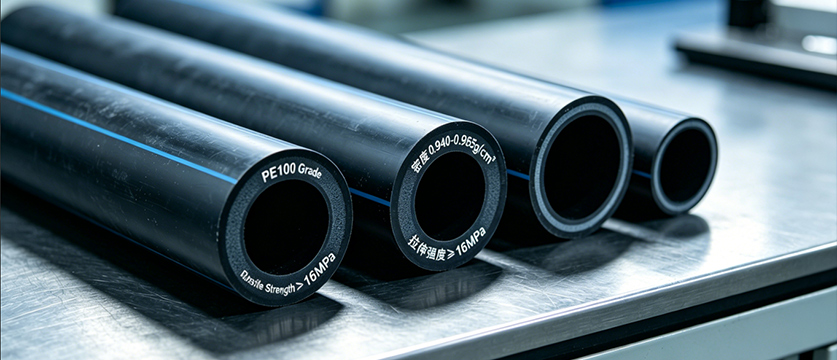
With rising requirements for pipeline reliability in municipal, mining, water conservancy and infrastructure projects, modern HDPE pipes have achieved significant technical upgrades in mechanical performance and environmental adaptability through raw material improvement and process innovation. All optimized technical indicators fully comply with mainstream industry standards including GB/T 13663-2018 and ISO 4427, ensuring stable and professional performance for complex engineering conditions.
The technical upgrade covers three core dimensions. At the raw material level, premium PE100 virgin HDPE resin is adopted, with density controlled between 0.940–0.965g/cm³ and melt flow rate stabilized at 0.3–1.5g/10min (190℃, 2.16kg). Scientific proportions of impact modifiers and anti-aging additives are added to enhance overall durability and environmental resistance from the source.
In terms of mechanical properties, upgraded HDPE pipes deliver tensile strength ≥16MPa, elongation at break ≥350%, and 23℃ impact strength ≥10kJ/m². Even at low temperatures of -20℃, the impact strength remains above 8kJ/m², with zero failure in drop weight impact tests (0℃, 10kg, 2m). This outstanding toughness enables the pipes to resist ground settlement, external impact and structural deformation in harsh construction environments.
For pressure resistance and long-term stability, optimized molecular structure and precise wall-thickness control ensure hydrostatic strength ≥10.0MPa (20℃, 1000h) under 1.6MPa working pressure, supporting a service life of over 50 years. The upgraded pipes adapt to multiple SDR specifications including SDR11, SDR17.6 and SDR26, meeting diverse pressure-grade project requirements.
In production processes, high-precision high-speed extrusion technology is applied, with extrusion temperature controlled at 180–220℃ and running speed at 8–15m/min. Combined with segmented cooling and shaping systems, the finished pipes achieve outer diameter deviation ≤±0.3% and wall thickness deviation ≤±10%, with zero bubbles, cracks or surface defects.
The optimized butt fusion welding process strictly controls welding temperature at 200–220℃ and fusion pressure at 0.3–0.5MPa. The welded joints achieve tensile strength equal to the pipe body with zero leakage, perfectly suitable for long-distance pipeline laying and trenchless construction, greatly improving construction efficiency and project safety.
With comprehensive performance optimization, upgraded HDPE pipes are widely applicable to municipal water supply and drainage, mine tailings transportation, agricultural irrigation, and chemical medium delivery. Compared with traditional pipelines, they show prominent advantages in low-temperature resistance, corrosion resistance and high-pressure stability, providing reliable technical guarantees for modern engineering projects.