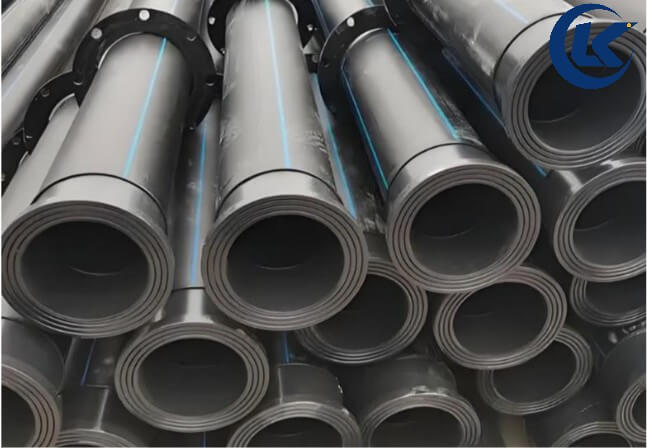
What Is an HDPE Flange Connection?
An HDPE flange connection is a detachable joint that joins high-density polyethylene (HDPE) pipe to valves, pumps, tanks, or metal pipelines using a flange assembly. Unlike permanent butt fusion joints, a flanged connection can be disassembled and reassembled — making it ideal for equipment that requires periodic maintenance.
The basic HDPE flange assembly consists of:
- ✅HDPE stub end (or flange adaptor) — fused to the HDPE pipe
-
- ✅Ductile iron backing flange — provides the bolt-hole pattern and mechanical strength
-
- ✅Gasket — creates the seal between flange faces
-
- ✅Bolts, nuts, and washers — compress the gasket
-
-
1.HDPE Stub End (Lap Joint Stub)
The most common type. A short HDPE sleeve is butt-fused to the pipe end, and a loose backing flange slides over it. The stub end’s back face rests against the backing flange.
Used with: Ductile iron or steel backing rings.
-
2.HDPE Flange Adaptor (Flange Fitting)
A pre-molded HDPE fitting with an integrated flange face. It is socket-fused or butt-fused to the pipe in one piece. More compact than a stub end + backing ring combination.
-
3.Ductile Iron Backing Flange (Backing Ring / Backup Ring)
The mechanical component that holds the stub end in place. Made from ductile iron (ASTM A536), available with painted or FBE fusion-bonded epoxy coating. Standard drilling patterns include ANSI B16.5 Class 150, EN 1092-1, and AWWA C207.
HDPE Flange vs. Steel Flange
|
Feature
|
HDPE Flange Assembly
|
Steel Flange
|
|
Weight
|
Light — easy to handle
|
Heavy — requires lifting equipment
|
|
Corrosion Resistance
|
Excellent — no coating needed
|
Requires galvanizing or painting
|
|
Installation
|
Quick fusion + bolt-up
|
Welding or bolting only
|
|
Service Life
|
50+ years, maintenance-free
|
15–25 years, regular maintenance
|
|
Leak Rate
|
Zero leak with fused joints
|
Prone to gasket aging and joint failure
|
|
Cost
|
Lower total cost over lifecycle
|
Lower upfront cost, higher maintenance
|
|
Flexibility
|
Absorbs ground settlement and vibration
|
Rigid — susceptible to fatigue cracks
|
Please send your request to the email address:sales@mfgpipe.com (We will respond to you within 24 hours).
Step-by-Step Installation Guide
Step 1: Prepare the Pipe End
Cut the HDPE pipe square and deburr the end. Ensure the pipe end is clean and flat.
Step 2: Slide on the Backing Flange
Slide the ductile iron backing flange onto the pipe before fusing the stub end. Confirm the bolt holes align with the mating flange.
Step 3: Butt-Fuse the Stub End
Use a butt fusion machine to fuse the HDPE stub end to the pipe end. Follow standard fusion procedures: heat, butt, cool.
Step 4: Cool and Position
Allow the fusion joint to cool completely (do not move during cooling). Slide the backing flange into position behind the stub end collar.
Step 5: Install the Gasket
Place a compatible gasket (EPDM for water, NBR for oil/gas) between the stub end sealing face and the mating flange.
Step 6: Align and Bolt Up
Align bolt holes. Insert bolts with washers. Hand-tighten all bolts first, then torque them in a crisscross (star) pattern in 2–3 passes to ensure even gasket compression.
Step 7: Pressure Test
After assembly, perform a hydrostatic pressure test at 1.5× working pressure. Hold for 30 minutes and check for leaks.
Watch out: Do not over-torque. Over-tightening can crush the HDPE stub end or damage the gasket. Follow the bolt torque specification provided by the fitting manufacturer.
Flange Standards, Sizes & Pressure Ratings
Common Flange Standards
|
Standard
|
Region
|
Typical Class / Pressure
|
|
ANSI/ASME B16.5
|
USA
|
Class 150, Class 300
|
|
EN 1092-1
|
Europe
|
PN6, PN10, PN16, PN25
|
|
AWWA C207
|
USA (water)
|
Class D, E, F
|
|
AS 4087
|
Australia
|
PN16, PN25
|
|
JIS B 2220
|
Japan
|
10K, 20K
|
Typical HDPE flange assemblies range from DN25 (1 inch) to DN600 (24 inches), with larger sizes available for custom projects.
Pressure depends on the pipe SDR:
- ✅SDR 17.6 → PN10 (10 bar)
-
Common Problems & Troubleshooting
Problem 1: Flange Interface Leakage
- ✅Causes: Gasket aging, uneven bolt torque, warped flange face, dirt on sealing surface
-
- ✅Solution: Replace gasket, re-torque in star pattern, clean flange faces, inspect for warping
-
Problem 2: Stub End Cracking
- ✅Causes: Over-tightened bolts, impact damage, low-quality material
-
- ✅Solution: Use proper torque, handle with care, specify PE100 virgin material
-
Problem 3: Flange Alignment Issues
- ✅Causes: Pipe movement after fusion, thermal expansion, misaligned mating flange
-
- ✅Solution: Allow cooling before positioning, use expansion loops for long runs, check alignment before bolting
-
Problem 4: Corrosion on Backing Flange
- ✅Causes: Uncoated painted flange in buried or corrosive environment
-
- ✅Solution: Specify FBE (fusion-bonded epoxy) coating for buried or corrosive service
-
FAQ
What is the difference between a backing ring and a backing flange?
They are the same component. “Backing ring,” “backup ring,” and “backing flange” all refer to the ductile iron ring that provides bolt-hole support behind an HDPE stub end.
Can I reuse a ductile iron backing flange?
Yes, if it is free from cracks, deformation, and bolt hole damage. Inspect it carefully before reuse.
What gasket material should I use?
- ✅Water / wastewater: EPDM
-
- ✅Oil / gas / hydrocarbons: NBR (nitrile)
-
- ✅Chemical service: Consult chemical compatibility charts
-
How do I choose between stub end and flange adaptor?
Stub end + backing ring is more cost-effective for large diameters. Flange adaptors are more compact and easier to install in tight spaces.
Looking for HDPE Flange Fittings?
At MfgPipe (Henan Lukuang Industry), we manufacture a complete range of HDPE flange fittings — stub flanges, ductile iron backing rings, flange adaptors, and butt fusion fittings — all in PE100/PE4710, certified to ISO 4427, EN 12201, and ASTM D3034.
[Request a Quote] — send your size, standard, and quantity, and we’ll reply within 24 hours with a factory-direct price.
Browse related products:
Please send your request to the email address:sales@mfgpipe.com (We will respond to you within 24 hours).