Large diameter plastic pipes play an important role in modern water supply, drainage, irrigation, mining, and industrial pipeline projects. Compared with traditional steel, ductile iron, and concrete pipes, plastic pipes can offer advantages such as corrosion resistance, lighter weight, smooth internal surfaces, and efficient installation.
Among the most commonly used materials are HDPE (High-Density Polyethylene) and PVC (Polyvinyl Chloride). Both materials are widely used in large-scale pipeline systems, but they have different characteristics in terms of flexibility, stiffness, jointing methods, pressure performance, and installation requirements.
Choosing between large diameter HDPE pipe and large diameter PVC pipe should therefore be based on the actual project conditions rather than material price alone.
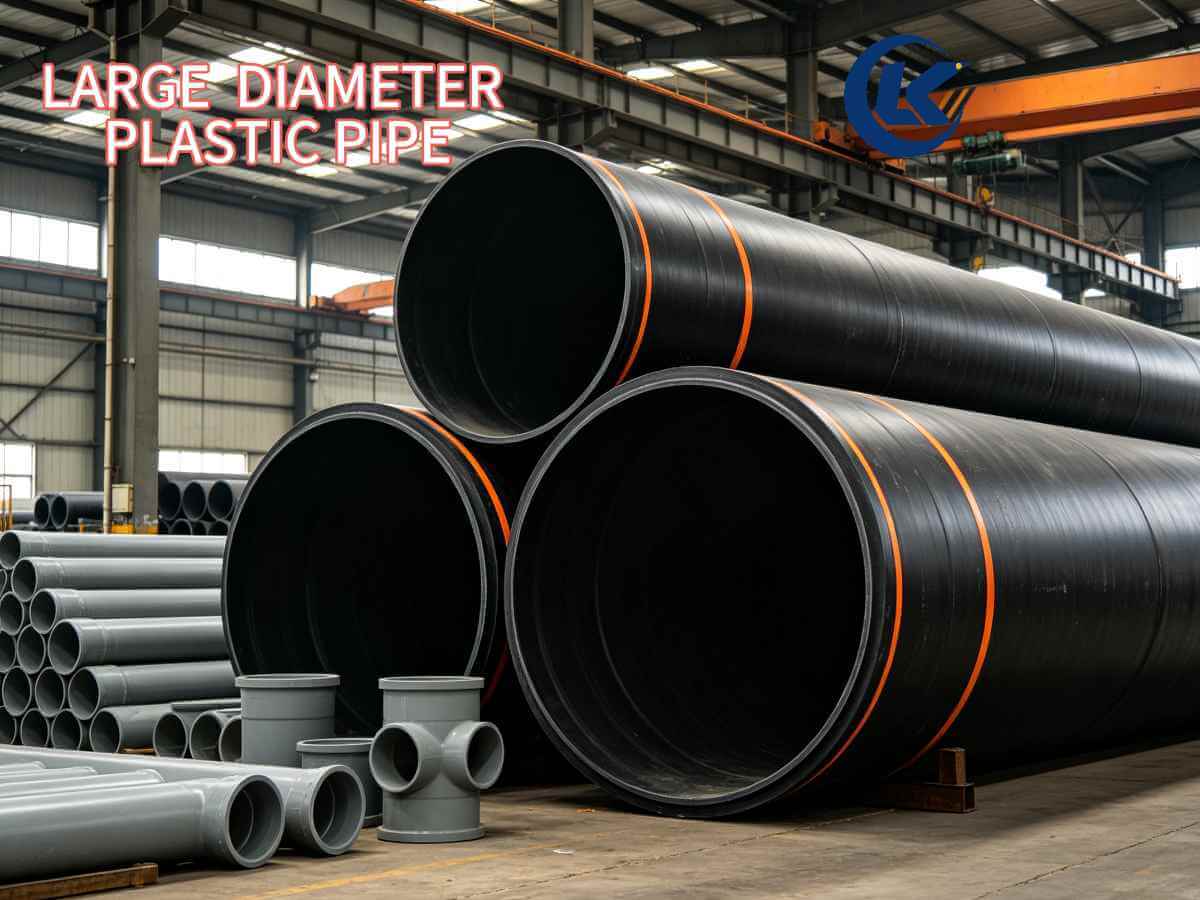
There is no single international definition of a large diameter plastic pipe. The classification can vary according to the material, applicable standard, country, and application.
In many engineering and procurement projects, plastic pipes with diameters of DN300, DN400, or larger are commonly considered large diameter pipes. In major water transmission, mining, marine, and industrial projects, HDPE pipes can reach diameters of DN1600, DN2000, or even larger.
Large diameter plastic pipes can generally be divided into two main categories:
Pressure pipes are used for applications such as:
For pressure applications, the pipe must be selected according to working pressure, surge pressure, pipe diameter, wall thickness, operating temperature, and applicable standards.
Non-pressure pipes are commonly used for:
For these systems, ring stiffness, burial depth, soil conditions, groundwater, traffic loads, and backfill quality are important design considerations.
It is important to remember that large diameter describes the pipe size, not its pressure capacity. Two pipes with the same outside diameter can have very different pressure ratings because of differences in material, wall thickness, SDR, structural design, and manufacturing standards.
HDPE stands for High-Density Polyethylene. Large diameter HDPE pipes are widely used in water transmission, mining, industrial pipelines, irrigation, trenchless installation, and marine applications.
One of the main characteristics of HDPE is its combination of flexibility, impact resistance, corrosion resistance, and reliable fusion jointing.
HDPE pipe is more flexible than many traditional rigid pipe materials. Within the manufacturer’s specified limits, it can accommodate certain ground movements, uneven settlement, and changes in terrain.
This makes large diameter HDPE pipe particularly useful for:
However, flexibility does not mean that HDPE pipe can be bent without restriction. The allowable bending radius depends on pipe diameter, SDR, temperature, material grade, and installation conditions.
The manufacturer’s minimum bending radius should always be followed.
Large diameter HDPE pipes are commonly joined using butt fusion. Electrofusion, flanged connections, and mechanical couplings may also be used depending on pipe size and project requirements.
A properly completed fusion joint can create a continuous pipeline with fewer mechanical connections and seals. This can reduce potential leakage points and provide good resistance to ground movement.
Fusion quality depends on several factors, including:
For large projects, fusion parameters and inspection records should be properly maintained.
HDPE does not suffer from the electrochemical corrosion commonly associated with steel pipes. It can perform well in many soil and water environments and can be suitable for applications where corrosion resistance is important.
HDPE also provides good abrasion resistance in many applications involving liquids containing suspended solids. This makes it attractive for certain mining and slurry transportation systems.
Actual service life, however, depends on operating conditions such as particle hardness, particle concentration, flow velocity, bends, temperature, and system design.
Large diameter HDPE pipe can be installed using a variety of methods, including:
Its fusion capability allows long sections of pipe to be assembled before installation, which can be particularly useful for long-distance and difficult-to-access projects.
HDPE also has limitations that should be considered during design.
Compared with PVC, HDPE has a lower material stiffness. For buried large diameter HDPE pipes, proper bedding, side-fill support, and backfill compaction are therefore especially important.
Operating temperature can also affect HDPE pressure performance. When the conveyed medium operates above the standard reference temperature, an appropriate pressure derating calculation may be required.
During transportation and storage, the pipe should be protected from deep scratches, concentrated loads, excessive deformation, and prolonged exposure to unsuitable conditions.
PVC, particularly PVC-U, is widely used for municipal water supply, irrigation, drainage, wastewater systems, and industrial water transmission.
Compared with HDPE, PVC has a relatively rigid pipe body and higher material stiffness. It is commonly supplied in pressure and non-pressure configurations depending on the application and applicable standard.
Large diameter PVC pipes may be manufactured according to standards such as ISO, EN, ASTM, AWWA, and applicable national standards.
When purchasing large diameter PVC pipe, buyers should confirm:
A nominal diameter or inch size alone is generally not enough information for an accurate quotation.
PVC-U has relatively high material stiffness. With proper design and installation, it can effectively resist external soil and traffic loads.
This characteristic makes PVC suitable for many buried municipal water, irrigation, drainage, and industrial applications.
However, buried plastic pipe works together with the surrounding soil. Proper trench preparation, side-fill support, and backfill compaction remain essential.
PVC pipe has a smooth internal surface and does not rust internally.
Its hydraulic characteristics can remain relatively stable during long-term operation, helping reduce friction losses in appropriately designed systems.
The required pipe diameter should still be determined through hydraulic calculations that consider flow rate, velocity, pipeline length, fittings, local resistance, and available pressure.
Large diameter PVC pipes commonly use rubber-ring push-fit joints.
Compared with fusion jointing, push-fit installation does not require on-site heating equipment. This can simplify installation and improve construction efficiency.
During installation, contractors should pay attention to:
PVC can provide a good balance between material cost, installation efficiency, hydraulic performance, and maintenance requirements.
For municipal water distribution, irrigation, conventional drainage, and stable-ground projects, large diameter PVC pipe can be an economical solution when correctly designed and installed.
PVC generally has less flexibility and impact resistance than HDPE.
Special care should therefore be taken during transportation, lifting, storage, and installation, particularly under low-temperature conditions.
PVC pipes also cannot normally be butt-fused into long continuous strings in the same way as HDPE. For projects involving significant ground movement, long pull-in installation, or difficult terrain, HDPE may offer advantages.
Pressure surge is another important consideration. Pump starts, pump shutdowns, rapid valve closure, and elevation changes can create transient pressures significantly above normal operating pressure.
PVC pressure pipe should therefore be selected based on both normal and transient operating conditions.
There is no single material that is always better for every large diameter pipeline project.
The correct choice depends on the project environment, operating conditions, installation method, and required performance.
| Selection Factor |
|
|
| Pipe characteristics | Flexible | Relatively rigid |
| Common jointing | Butt fusion, electrofusion, flanges | Rubber-ring push-fit, flanges |
| Pipeline continuity | Can form continuous fused sections | Individual pipe sections |
| Ground movement | Excellent tolerance | Better for stable conditions |
| Impact resistance | Generally high | Requires more careful handling |
| Long-distance transmission | Excellent | Suitable for many applications |
| Mining applications | Strong option | Depends on design |
| Municipal water supply | Excellent | Excellent |
| Irrigation | Excellent | Excellent |
| Installation equipment | Fusion equipment may be required | Push-fit installation equipment |
| Typical project environment | Soft ground, difficult terrain, long-distance pipelines | Stable trenches, municipal and conventional projects |
Large diameter HDPE pipe may be a strong option when a project involves:
Large diameter PVC pipe may be a good option for:
The final selection should be based on hydraulic calculations, structural design, operating conditions, applicable standards, and construction requirements.
Choosing a large diameter plastic pipe involves more than selecting a diameter.
First determine what the pipeline will transport.
Possible media include:
For drinking-water projects, the pipe, fittings, gaskets, and other wetted components should comply with the applicable local requirements.
For chemical applications, material compatibility should be evaluated according to the chemical composition, concentration, temperature, and exposure time.
Pressure pipe selection should consider:
For HDPE, SDR (Standard Dimension Ratio) is an important parameter.
For the same material grade and applicable standard, a lower SDR generally indicates a thicker wall and higher pressure capacity.
For PVC, pressure class, PN rating, or other classifications may be used depending on the applicable standard.
Pipe diameter should be selected according to the required flow rate and hydraulic conditions.
An undersized pipe can result in:
An oversized pipe can increase:
The final diameter should therefore be determined through appropriate hydraulic calculations.
For buried plastic pipes, external conditions are as important as internal pressure.
The design should consider:
For non-pressure drainage systems, ring stiffness is particularly important.
Large diameter pipes can occupy significant shipping volume.
Before purchasing, the project team should confirm:
The total project cost should be evaluated rather than comparing pipe prices alone.
Transportation, fittings, installation equipment, excavation, backfilling, labor, and long-term maintenance can all affect the final project cost.
Correct installation is essential to achieving the expected service life of a large diameter plastic pipeline.
Large diameter solid-wall HDPE pressure pipes are commonly connected using butt fusion.
Before fusion, contractors should verify:
Fusion records should be retained for major projects.
Large diameter PVC pipes commonly use rubber-ring push-fit joints.
The socket, spigot, and gasket should be clean and undamaged. The gasket should be correctly positioned, compatible lubricant should be used, and the pipe should be inserted to the required depth.
Regardless of the pipe material:
Even high-quality pipe can experience deformation, leakage, or premature failure if installation quality is poor.
A request such as:
DN500 HDPE pipe
or:
12-inch PVC pipe
may not contain enough information for an accurate quotation.
Buyers should also specify the applicable standard, pressure class or SDR, pipe length, jointing method, quantity, and application.
Normal operating pressure is not the only pressure condition that matters.
Water hammer and other transient pressures can occur during pump start-up, pump shutdown, rapid valve closure, and changes in elevation.
Ring stiffness is important, but it is not the only factor affecting buried pipe performance.
Trench conditions, soil type, backfill quality, groundwater, traffic loads, and installation quality must also be considered.
For large diameter projects, fittings and jointing equipment can represent a significant part of the overall project cost.
HDPE projects may require fusion machines, power supplies, lifting equipment, and trained operators.
PVC projects may require specific gaskets, lubricants, fittings, flanges, and installation tools.
To receive an accurate quotation, buyers should provide as much of the following information as possible:
The more complete the project information, the more accurately a manufacturer can recommend the appropriate pipe specification.
Large diameter plastic pipe is not a single product. It includes different materials, diameters, wall thicknesses, pressure classes, jointing systems, and installation methods.
Large diameter HDPE pipe offers excellent flexibility, impact resistance, corrosion resistance, and fusion jointing capability. It is particularly suitable for long-distance transmission, mining, soft ground, trenchless installation, and marine applications.
Large diameter PVC pipe offers relatively high stiffness, a smooth internal surface, efficient push-fit installation, and competitive overall project economics. It is widely used for municipal water supply, irrigation, drainage, and conventional industrial water systems.
The right question is therefore not simply “Is HDPE or PVC better?”
Instead, pipe selection should begin with the project’s:
Treating the pipe, fittings, joints, transportation, and installation process as one complete system is essential for achieving reliable long-term pipeline performance.
If you are planning a water supply, irrigation, drainage, mining, or industrial pipeline project, Henan Lukuang Industry Co., Ltd. can provide PVC and HDPE pipe solutions according to your project requirements.
Send us your pipe material, diameter, SDR/PN or pressure class, quantity, application, project country, and delivery requirements.
Our team can help evaluate the suitable pipe specification and provide a project-specific quotation.
Contact MFG for your large diameter PVC or HDPE pipe requirements.
There is no universal definition. In many engineering projects, pipes of DN300, DN400, or larger are commonly considered large diameter pipes. The classification depends on the material, standard, and application.
It depends on the project. HDPE is generally advantageous for ground movement, long-distance transmission, mining, and trenchless applications. PVC can be an economical option for municipal water supply, irrigation, drainage, and projects with stable ground conditions.
Yes. The material grade, diameter, SDR, operating temperature, working pressure, and surge pressure must all be considered when selecting the pipe.
Yes. PVC pressure pipes are widely used in municipal water distribution, irrigation, and industrial water transmission when properly designed and manufactured according to the applicable standard.
SDR means Standard Dimension Ratio. It is the ratio between the pipe’s nominal outside diameter and nominal wall thickness. For the same material and standard, a lower SDR generally indicates a thicker wall.
SN generally describes ring stiffness for non-pressure buried pipes, while PN describes nominal pressure under specified conditions. They represent different performance characteristics and should not be directly substituted for each other.
Large diameter solid-wall HDPE pipes are commonly joined by butt fusion. Electrofusion, flanged connections, and mechanical couplings may also be used depending on project requirements.
Rubber-ring push-fit joints are common for large diameter PVC pipes. Flanges, mechanical couplings, and other approved connection systems may also be used.
Plastic pipes can replace steel or concrete in many water, drainage, mining, and industrial applications. However, high-temperature, extremely high-pressure, fire-protection, and heavily loaded applications require project-specific engineering evaluation.
Buyers should provide the pipe material, applicable standard, diameter, SDR/PN/SN or pressure class, quantity, pipe length, conveyed medium, operating conditions, jointing method, project country, delivery port, and required trade terms.